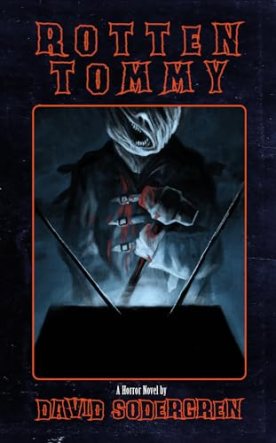
Book Review: Rotten Tommy by David Sodergren

210387322

Title: Rotten Tommy

Author: David Sodergren

Release date: May 6th, 2024

“Let’s go back,

To Rumplejack,

We’ve been away too long.”

I think each of us has a childhood show we used to watch that scared the ever-living-crap out of us. I distinctly remember how much the movie ‘The Monster Squad’ traumatized me at an early age, and because we watched it for the first time (and usually each year after) at Christmas, I always thought of it as a Christmas-Horror movie, which is funny to think that now. But, while that show traumatized me, it didn’t hold a candle to another show I only saw two episodes of and then it disappeared into the ether, but never left my brain.

As a young kid, most Saturday mornings meant I’d wake up and immediately run down the street, and go to my grandparents place that was only five houses down. They had satellite TV, which meant cartoons and channels I never even dreamed existed. At some point, I caught these two episodes of this show and then never saw it again. It could be that they actively changed the channel when it came on, spurred by the nightmares I had for weeks. I never knew the name and for many, many years, all I could think about was this crazy show involving kids, puppets, a giant, islands and a portal. It actually wasn’t until YESTERDAY (March 28th, 2024) while messaging with David about this novel, that I did a deeper dive and FOUND THE SHOW. For those wondering, it was called ‘Blizzard Island.’ You can read about it here – https://en.wikipedia.org/wiki/Blizzard_Island – and watch part one of episode one here – https://www.youtube.com/watch?v=VPUlOru5IIY.

So, how does this relate to Sodergren’s forthcoming masterpiece? Well, I wasn’t completely sure if this kids show that scared me to my core was actually a real show. I thought it was, but with no concrete evidence that it actually existed, I always questioned myself that it did.

Which brings us to ‘Rotten Tommy.’ What if a kids show was made that was so cursed that almost everyone involved died? Think Tutankhamen Tomb’s curse. An urban legend. A creepypasta of sorts.

It was maybe two years ago that David had messaged me with the early inklings of this story, about the concepts and where he wanted to go, and I can confidently say that while those early bits were amazing, they don’t hold a candle to what he delivered.

What I liked: The novel follows Becky, an screenwriter in her early 40’s who has been diagnosed with autism on recently. To her, it explains a lot. Her mannerisms, her quirks and her love of her stuffed penguin, Grumpus. To her husband, John, it drives a wedge between the woman he married and the ‘weirdo’ he now lived with. Becky’s mother was an actress, but she disappeared forty-years ago and is presumed dead. Her father is now in a long-term care home suffering from dementia, and her sister Flora is self-centered and uncaring.

While some home renovations are happening, the workers alert Becky that they’ve found something in the wall. What they’ve found are three old video cassette tapes, marked ‘Rumplejack,’ and it’s from that point on that Sodergren takes us on an absolutely astounding ride. On the tapes are the forgotten episodes of the pilot for ‘Rumplejack,’ a show set in a small, ocean-side town, with a lighthouse, a talking horse sheriff named ‘Stickemup,’ and a hand puppet king, known as ‘King Sausage.’ And as soon as you watch the episode, Tommy awakens, and he won’t stop until he finds you.

The character of Tommy was a perfect mix of Jason and Michael Myers. This massive, disfigured brute who speaks little, but swings a big club and is seemingly impervious to pain. Becky begins seeing him, and Tommy begins to let her know he’s near. People die. Horribly. And not until she partners up with a cop who always watched the video, does she feel like she have an ally, someone who believes her and who doesn’t judge her for her mannerisms.

A surprising element to this was the light, humorous moments. Often based around Jason Statham (you’ll understand once you read it), David perfectly placed these moments, and I say this as someone who generally doesn’t like humor in my horror.

Of course, all roads lead to this mythical town of ‘Rumplejack,’ and its here that the novel really shines. In fact, one scene was so masterful I messaged David to let him know he’d written something that made me question why I even write.

The story itself is a perfect blend of the joy we got while watching our kids shows with through the eyes of our youthful innocence, while not understanding some of the horribly dark content that was being glossed over by the use of hand puppets and shiny music.

The ending was perfect and David uses a phenomenal tie-in with the video itself, which had me so very happy, and it does leave the potential for further stories set within the same universe, especially when it relates to a mysterious corporation that is introduced.

What I didn’t like: Honestly, my only quibble was that a minor character within – a guy who transfers video’s and owns an emporium – didn’t factor in more at that time. He had an internet series that was spot on for the ‘Rumplejack’ tapes and I was hoping he’d play a slightly bigger role, but overall it didn’t change the story at all. I was just hoping to see some exciting meta moments from him, even relating to David’s other works.

Why you should buy this: When David released ‘The Haar,’ I didn’t know how he could top that. All of his work leading up to that novel was steadily growing in scope, conceptual execution and emotional development. It did everything people wished ‘The Shape of Water’ wanted to do. But with ‘Rotten Tommy’ he’s outdone even ‘The Haar.’ Tommy is a character that should please current fans of his work and invite in a whole new world of readers (and Trevor Henderson’s amazing cover art will grab even more folks’ attention), and the world and town of ‘Rumplejack’ is simply Jim Henson level brilliant. This is a novel that I’ll forever be upset about that I wasn’t able to write it. It ticks every single box in a story that I love about horror mixed with fantastical elements and the use of the missing TV show aspect was pristine.

Sodergren has created a legion of fans and has readers from every corner of the globe – but I often still see him as criminally overlooked when it comes to lists and ravings etc. etc. I think ‘Rotten Tommy’ just might be his all-time masterpiece. His ‘IT’ or his ‘Dracula’ or his ‘The Demonologist.’ The novel that blows the world away and raises him to that next level of author-ship. The one that he so deserves. Fingers crossed he just remembers my name in a few years!

‘Rotten Tommy’ is one of the best books I’ve ever read from one of the best authors out there and I can’t wait for everyone to meet Becky and visit ‘Rumplejack.’ Just lock the door.

“Your friends await,

So don’t be late,

To help them sing this song.”

5/5
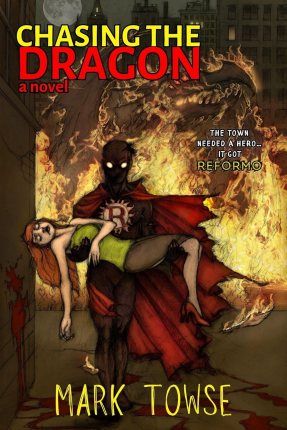
Book Review: Chasing the Dragon by Mark Towse

204587490

Title: Chasing the Dragon

Author: Mark Towse

Release date: March 23, 2024

*Huge thanks to Mark and Eerie River for sending me a digital ARC of this one!*

I’ll be honest here. I had no idea what I was getting into with this one. I knew it was a pseudo-superhero type story, but I saw snippets and some things online about it being humorous. Oh dear. I truly struggle with reading humour. Doesn’t matter if it’s fiction or non-fiction, there’s just something that really doesn’t connect with me. Saying that, I’m a massive fan of British/UK humour when it comes to series. The Inbetweeners, Cuckoo, Psychoville, and even the dark humour of The Misfits series are some of my most favourite shows I’ve ever watched. So, I went into this hoping that it would read kind of like one of those shows and to my delight, it was essentially a mix of all of them.

What I liked: The story follows Simon, struggling to make his horribly abusive mother proud. She’s dead, but her constant tearing down of him that she delivered over his entire life has left deep scars and now, he’s out to show her that he can do good. This is coupled with the reality that where he lives is now a cesspool. Crime is rampant, residents fear for their lives while drug use skyrockets and the streets are ran by Kingpins and the cops could care less.

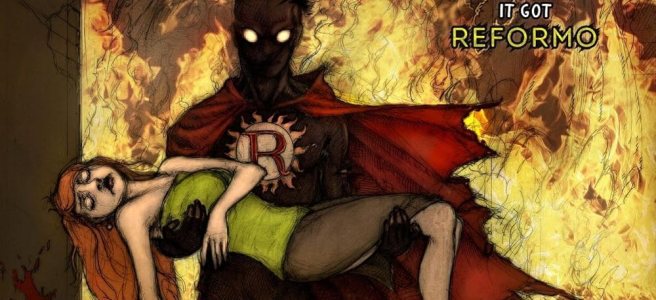
Bolstered by a few cheesy sayings his mother used to say, Simon decides that the only way for things to turn around is for someone to take the lead and start the change themselves. So, Reformo is born – Simon in a custom made suit – and he takes to the streets to try and make the wrongs go away.

Towse does a wonderful job of walking the line between silly and serious. We see Simon constantly battling that inner monologue of his mother ripping him to shreds. The truth is, while Simon cares, he is getting stronger and starting to understand that what she says no longer matters. He falls for a streetwalker, one who he promises to help her leave the life behind. And he slowly, incident after incident, gets the towns people on his side.

Simon is a wonderfully flawed character. Big heart, bigger dreams and for a long time, going head first with no fear. As things pick up and he makes his way from low level to thug, to mid level and ultimately to the highest of the high, his body gets beaten down, but his mind never falters. It makes for a highly engaging story, one that had me rooting for Simon all the way through.

The ending is great, a true bright spot when considering everything that Simon goes through and ultimately does the very rare job of giving the reader the idea that anything is possible and hope can light the darkest of days.

What I didn’t like: I did struggle with some of the ‘sillier’ aspects. I’m looking at you, names-of-thugs. Butter Balls and Bum Fluff and the like. I know it’s designed as a mood-lightener and a funny, tongue-in-cheek look at crime, but when it kept happening, it lost it’s hilarious touch and became an eye roller.

Why you should buy this: When an action-adventure book is done well, you’ll race through it and be whole-heartedly invested in the story and characters and this was 100% one of those books. Towse has created such an amazing figure with Simon/Reformo and it worked well to act as purely a story, but also as a larger piece on the state of the world. This was a really fun read and one that I’m glad to have tackled, as normally this wouldn’t be something I would ever seek out.

4/5

Andrew Pyper on becoming Mason Coile, ‘William,’ and loving the world from a distance.

IMG_20240317_162609

It’s safe to say that you’ve probably seen that I have an affinity towards Andrew Pyper’s novels. If you’re following my social media pages or casually asking me about books in real life, chances are an Andrew Pyper novel will make it’s way into the social media feed or conversation.

When I was in Toronto last year (hard to fathom it’s already almost a year ago!) Andrew shared some tidbits about his upcoming novel, his first under the pseudonym of Mason Coile. Originally under the secret title of ‘Daemon,’ it was actually announced in Publisher’s Weekly during the weekend I was out in Toronto, but at the time the details on when Mason’s identity would be revealed was unknown.

It was really intriguing to me, as a massive fan of Andrew’s work – he of the dozen bestselling novels, multiple film options and one of the biggest Audible releases in the last decade – that he was releasing something now, at this point in his career under a pseudonym and in a genre he’d not really dipped his toes into that far.

When ‘William’ was finally revealed, as well as with Mason being Andrew, the countdown began. When would ARC’s be available? How soon could I get my grubby paws on a copy, and just how awesome would it be? Even before digital ARC’s went live on Edelweiss and Netgalley, we got the news that there would be a sequel in 2025, titled ‘Exiles.’

After getting approved on Edelweiss for a digital copy, I tore through the novel that first weekend, then re-read it, soaking it in and really tried to get to the heart of this masterpiece Andrew had created.

You can read my full thoughts here – https://stevestredauthor.ca/2024/02/16/book-review-william-by-mason-coile/ – but I obviously wanted to see if Andrew would be up to an interview, and amazingly he was!

In the past, I’ve both been fan-boy-ish about my questions to Andrew (read: softball questions), and have also tried to push the questions a little bit. In this interview, I pushed harder than normal, and wouldn’t you know it, Andrew was selectively coy, partially vague, but did give a bit more in this interview than he has in previous interviews he’s done. So, for that I thank him!

Now, let’s get to the interview!

Steve: Is ‘William’ by Mason Coile a reinvention/rejuvenation of Andrew Pyper, the novelist?

Andrew: I like being two people. If I could be twenty people, that might be even better.

Steve: You mentioned that ‘Mason Coile’ specifically paid homage to your Irish roots and family. Did it take you long to come up with your pseudonym? Had you previously pondered potentially releasing a book under a pseudonym?

AP: I wanted a pseudonym that felt like my own name, but different. The goal was to not get too tricky or misleading about it. So even though Pyper is not exactly a common Irish name, neither is Coile, so I liked that about it. I also liked the suggestion of a coiled snake, something powerful and dangerous ready to strike.

I hadn’t really thought too hard about a pseudonym before ‘William,’ but once I was finished the manuscript I saw how it was distinct in interesting ways from my existing body of work. Sci-fi, told in almost “real time,” short. And the next ideas I was thinking about for novels also broadly fit these descriptors too. That’s when it occurred to me that maybe I was embarking on something new, something that could be considered a suite of stories to be presented under a new name.

Steve: When did the first formative bits of ‘William’ begin? I remember a few years back during a video chat we did, when I hosted a read-along for ‘The Guardians’ you mentioned you were working on a tech thriller. Our great friend, Randall Perry, had mentioned you’d read a ‘William’ short story at a reading. Did this begin as a short story?

AP: ‘William’ started as a short story which I sent out to a film producer I’d been in correspondence with for a while. He liked it, and from there I adapted the story into a screenplay. We shopped the project for a time, seeking a movie star attachment that never materialized. But I continued to believe in the story, I couldn’t let it go. That’s when I thought more about what the story could be and, over time, it eventually became a novel.

Steve: I’ve emailed you to kind of confirm my thoughts about this novel, which I shared in my review. There will, of course, be people who purely take this novel as a work of ‘just fiction.’ At what point did this novel become more than just a story? Did you find you had to be courageous and honest with yourself while writing it?

AP: I suppose there’s always something personal in every work of fiction. The degree to which this is the case varies in my own work, but this is only a rough estimation, because I do my best not to think about this aspect too much. I leave it to others to tease out the threads of biography that might exist in what I make up – I fear getting caught up in that spiderweb, or perhaps I fear what I might learn from the spider as it whispered in my ear. So, while I won’t deny the biographical overlaps you identified in your review, I’m hesitant to expand on them myself. Superstitious? In denial? Uncurious? Maybe I’m all of these. But I prefer to see the work in the most impersonal terms possible – keep the stories as stories.

Steve: The character of William itself seems to be an allusion to both technology and to the publishing world itself. Was William always the protagonist or were they a secondary character brought to larger prominence through subsequent drafts?

AP: William was always who he was. Protagonist? Antagonist? I’d say he’s more the latter, but of course, he’s a complicated being. He’s challenging as a character because he changes so significantly over the course of the story – he changes himself, pronounces himself, makes himself up as he goes along. This lies at the heart of my personal anxiety about technology itself: not what it is designed to do, but all the unanticipated things it ends up doing on its own.

Steve: Let’s discuss technology. This novel both embraces tech and rails against tech. We see what Henry built and developed, but also how the house has all these features to make life easier, and how Lily has these amazing glasses. Where do you sit when it comes to technology. You’ve spoken before in the past about disliking social media. But outside of that, are you a fan of technology and some of the exciting new shiny things? Or do you hate where things are going?

AP: Contemporary human beings – especially the smart ones, but the stupid ones too – are flawed by arrogance. We see this no more clearly than in the tech world, where brilliant engineers, financed by less-than-brilliant but powerful venture capitalists, make incredible things they either don’t consider the implications of, or don’t care. The tech world’s self-justification ends with “Look at this!” and then the companies get bought out by bigger companies and everyone walks away rich. It’s a world of making things that could destroy us and not giving a flying fuck as long as you’re the first to do it. It’s Oppenheimer times a million. And none of it is questioned, let alone regulated. In fact, most of us can’t wait to get our hands on it and act as the first voluntary lab rats. So, while I’m not fearful of technology in itself, I’m extremely fearful of human arrogance and thoughtlessness when married to technology.

Steve: And on that note, let’s discuss AI. Recently you shared that a number of your books had been illegally used to aid in the AI Chat programs (as did dozens and dozens of other authors). Do you see any benefits of AI?

AP: I see many benefits to AI if its uses are controlled, regulated, safe. What are the chances of that? None.

Steve: Henry is a unique main character. Awkward, intelligent, scared of the wide world. Was Henry a completely formed adaptation of yourself, or was it a case of further introspection that modified the character himself?

AP: For me, I need to find something at the core of my main character that I also find in myself in order to inhabit them. In the case of Henry, it was his obsession with his “project” – a robot for him, a book for me. And yes, while his case of agoraphobia is extreme, I certainly go out less these days than I used to. But it was Henry’s bafflement with the world that was an invention (I don’t know much, but I’m more familiar with people than he is). That’s where his sweetness lies, and also his tragic possibilities.

Steve: How much did the Covid pandemic influence this novel? Do you think if the pandemic hadn’t occurred, you’d still have written this novel?

AP: In a way, ‘William’ is a pandemic novel without a pandemic. There’s no virus, no masks, none of that. But it is about self-isolation, and ways of escaping it. Was I aware of that aspect of the novel as I was writing it? Not really. I was more fixated on the spiritual and conceptual questions the story raised – what is the nature of an A.I. afterlife? – than that. But there’s so much about the circumstances in which a novel is written that finds a way into the novel without my awareness that it’s inevitably the case that the “aboutness” comes as a surprise to me once it’s done.

Steve: Henry’s wife Lily is pregnant. Was her pregnancy a metaphorical concept around ‘a new story’ idea? As in, within a writer’s mind, there’s always something that is being born.

AP: Lily’s pregnancy, to me, represents less the idea of a gestating story than it does the organic, the fundamentally human. William is a mechanical creation. The house is enhanced in an assortment of computerized ways. Drones buzz by over the street outside. But Lily’s body is creating something that has nothing to do with that – which is why it sparks so much of William’s attention. He is becoming something new. So is Lily. And William is all about becoming.

Steve: Let’s talk about the agoraphobia aspect. Firstly, was that completely inspired by Covid? Did you yourself develop agoraphobia? You’ve been a professional writer, writing from home, for thirty years. When the pandemic hit, it essentially closed off the entire outside world to you. How did you manage that? Did you become more introverted? More intrinsic in nature? Or did you desire to be out in the wider world?

AP: I wouldn’t say the pandemic left me agoraphobic, but I did adapt to life at home in ways that definitely still linger, even if the rules have changed and the world opened up. I find that I don’t need the social as much as I used to, I just need a handful of good friends, and my kids to shuttle around, and collecting groceries on foot in my particular corner of the city. So yes, I’ve become more introverted. But I don’t feel closed off. It may simply be the inevitable consequence of getting older, moving deeply into my Dad Years, watching the world and loving the world but from a greater distance.

Steve: A sequel has been already announced for 2025, titled, ‘Exiles.’ We see that it has shifted further into the future and set on Mars. I know you won’t go too far into any plot points or any details, but was ‘William’ always considered book one with a sequel? Or was ‘Exiles’ born later on and it made sense to continue the story?

AP: I see ‘William’ and ‘Exiles’ as related but distinct. Both are brisk thrillers that deal with serious questions related to technology in what I hope are entertaining ways that don’t slow the fun down. The sci-fi thread in these stories arose quite organically, which is a bit odd, as I’ve never really been a big reader of sci-fi before. I come to the genre with excitement and innocence.

Steve: And lastly, is there anything you can share about a potential Oracle 3?

AP: Oracle 3 is coming! I honestly think that’s all I can say about it at this point.

*Steve note – in Andrew’s recent podcast appearance on The Stratford Slice, he confirmed that Oracle is currently being adapted for film, but didn’t share anything regarding Oracle 3.*

*****

I can’t thank Andrew enough for taking the time to answer these questions! I always appreciate his kindness and his willingness to answer questions regarding his work.

You can find all of Andrew’s work at his website;

http://www.andrewpyper.com/

‘William’ will be released on September 10th, 2024 and can be preordered below;

Universal link;

https://books2read.com/u/bz6NM2

Publisher link;

https://www.penguinrandomhouse.com/books/752545/william-by-mason-coile/

Book Review: The House at the End of Lacelean Street by Catherine McCarthy

81263019

Title: The House at the End of Lacelean Street

Author: Catherine McCarthy

Release date: April 16th, 2024

*Huge thanks to for the digital ARC of this one!*

I’ve long been a fan of Catherine’s mystical way of telling a story. Not everything is as it seems and you feel like you’re in a hypnotic trance as you dance through the world of hers you’re in.

Which was what I expected going into her newest release, ‘The House at the End of Lacelean Street.’ Often times, when I see a book with a title like this, I’m tentative at trusting anything that occurs at the start of the book. If classic novels and movies have taught me anything, it’s that what begins in these stories isn’t always what is ‘actually’ happening, so, I suspected Catherine was up to some deviousness.

What I liked: The book follows three strangers, who all get on the same bus and arrive at the same destination – the house at the end of Lacelean Street. Oddly, a key with specific instructions awaits each of these people, and, while they kind of question the how, they all float along, doing as the instructions say, while also following what they feel they must do.

We get a middle-aged woman named Claudia, an older man named Howard, and a young, drug-addicted woman named Stacey. These three must learn to work together to uncover what is going on at the house, but also to unlock their own memories and what it was that brought them to this very strange place.

McCarthy does a wonderful job of being coy, of actively engaging the characters with ‘motions and reasons,’ while not having them do much at all. They must eat at the same time, arrive at the library at the exact same time and remain in certain areas throughout. As little tidbits are revealed, like the truth about Howards dog, Claudia’s life and Stacey’s life, the bandages are ripped away, leaving the horrible, broken scars below.

It is within those moments that this book really shines. Where we get the emotional elevation and connection between them and we see the way that a hidden life has effected far more than they’d ever expected.

The ending was really well done, and, while the entirety of the story is a grey, hazy, Twilight-Zone homage, the ending is perhaps the most directly inspired by the classics section.

What I didn’t like: This will completely be a personal preference, but the one thing I felt kind of took me a bit away from the story was the appearance of Stephen King’s ‘IT.’ I was onboard with the appearance/reference The Great God Pan and The Wind in the Willows, but King’s book took me a bit out of the ‘suspending reality’ aspect. I can’t fully put my finger on it, but I think it was because I felt removed from this magical make believe work whenever it was discussed and jarringly put back into this one.

Why you should buy this: McCarthy has struck a fine chord with this one. For a novel that is filled with heavy themes and tons of heartache, this was ripped along and the tension she’s created throughout was palpable and built and built until the fantastic crescendo at the ending.

If you’re looking for an unnerving, chaotic novel where strangers are revealed one painful section at a time, look no further. Wonderfully dark.

5/5

The House at the End of Lacelean Street

Book Review: Hunter/Gatherer by Benjamin Percy

205839604

Title: Hunter/Gatherer

Author: Benjamin Percy

Release date: March 5th, 2024

Over the last few years, I’ve read a couple of Percy’s outstanding novellas – ‘North Border’ and ‘Wereworld’ – which were both fantastic. I’m not an avid comic book reader, but do know of his phenomenal output in that world, and as of yet, I’ve not yet read any of his long fiction, though I do own, ‘The Dead Lands,’ ‘Red Moon,’ and ‘The Ninth Metal.’ Why I’ve not read those yet is beyond me, especially considering that my friend, Mason McDonald has threatened to fly to Edmonton and force me to read them over and over again. But also, considering how fantastic the novellas have been that I’ve read, it makes no sense.

When ‘Hunter/Gatherer’ was announced, I hit that Kindle preorder button as fast as I could, and once it loaded on my Kindle, I dove into it two nights ago, struggling to sleep with how over-tired I was due to the head cold I was battling. Without knowing what it was about – I just assumed it was another werewolf story, ha! – I was in for a pleasant surprise. Quick paced, tension packed and carrying a wonderful environmental narrative, this was a novel’s worth of story jammed into a hundred pages of fury.

What I liked: The story kicks off with ultra-rich asshole, Trevor, wining and dining some influencers, along with his soon-to-be ex-wife, as they land on the moon. He’s about to publicly kick off his lunar space tourism business and wants to get some promo and press done ahead of time. Unfortunately, something has been growing on the moon, out of sight, and when it attaches itself to one of the folks and escapes on earth, Trevor does the only thing he can think of – he tracks down the one man who can track down this alien entity.

Enter Axel Crossgate. A man happy to live off the grid and who struggles with the death of his wife, a death that Trevor directly played a role in. Axel begrudgingly agrees to track this ‘thing,’ if only to satiate his own curiosity. Percy does a great job of creating these two characters, Trevor – who could very well be any of the uber-rich d-bags paraded daily in our news feeds, and Axel – the everyman, the guy who works better with his hands and prefers seeing wildlife in person than on a screen. Axel knows his place in the pecking order, both when it comes to Trevor, but also when it pertains to nature. And it’s this understanding that allows him to formulate a way to track the alien entity but to also work with it in a sense.

The extra-terrestrial was a unique ‘terra-former,’ one that caused rapid-cellular regeneration and with that, of course, opens up the super-rich to think of ways to become even richer. Greed is a heavy hand and Percy showcases that angle superbly. Which lead to a well executed ending.

I will add, this also featured some truly gorgeous illustrations from Brent Schoonover, which really highlighted the imagery Percy was painting throughout.

What I didn’t like: While I enjoyed Axel reconnecting with his daughter, it did feel a bit forced within the story and what ended up happening with her character was really predictable.

Why you should buy this: If you’re looking for a single sitting, fast-paced novella that packs a wallop, then look no further. We get some nature vs big tech themes, as well as a great ‘alien stowaway’ storyline that is always intriguing.

Percy always creates such amazing characters and the stories he surrounds them will are great. This one is no exception. And now, I need to read one of his novels!

5/5

Book Review: Eye of the Ouroboros by Megan Bontrager

65609332

Title: Eye of the Ouroboros

Author: Megan Bontrager

Release date: April 15th, 2024

*Huge thanks to Quill & Crow Publishing and Netgalley for the digital ARC of this one!*

I’ve always loved seeing the releases Quill & Crow Publishing have, but as of yet, haven’t dipped my toe into what they’ve released. Then, while cruising through Netgalley, I saw this one. The cover immediately had me excited, the title had me intrigued and then the synopsis screamed at me to read it. With this being Megan’s debut, I wasn’t worried, knowing full well that if Quill & Crow were releasing it, it would be a solid tale.

What I liked: Bontrager has delivered an unexpected gem. Not once did I get a sense that this was a debut, the storytelling – both depth and scope – were solid and controlled, which is a testament to what it is that Megan has created here.

The story follows Forest Ranger Theo, short for Theodora, a name she detests. Years ago, her sister Flora disappeared in the woods around the town they live in, so she’s made it her life mission to try and find what happened. Everyone blames Theo for Flora’s disappearance – even her parents, who treat her like she’s a blister that needs to be popped – so Theo gets hired on with the Rangers to be as close to the location as possible.

The woods there are strange. People go missing all the time. And it is Theo who finds them, looking harder and longer than anyone else. But with each person she finds, there’s little things she notices. From missing toes, to strange stories, it all adds up to something odd going on. Even the Forest Ranger handbook alludes to that. Rule #1 is for no Forest Ranger to take any set of stairs they may come across.

Bontrager sets the stage well, so that, when a conspiracy-theory believing character pops up and introduces her to the idea of what ‘is’ happening, at first she things they’re nuts. And then she believes them.

It is from that point on, when we learn of the Federal Bureau of Reality, that the story really shines. Bontrager weaves in an action-fueled quest with different portals, a strange government agency nobody knows about and the truth to what happened to Flora. Tensions remain high until the end and as the story goes on, each character becomes more and more fleshed out. Including Theo’s on again, off again, former lover, the reporter Delilah, who tried to bring more exposure to Flora’s disappearance, but in turn seemed to use it as career leverage.

Everything ramps up, leading to the ending which was cathartic, heartbreaking and completely expected, even if you didn’t want it to be.

What I didn’t like: Some may find the introduction of the ‘FBR’ to be comical. Bontrager keeps it serious and utilizes that narrative to strengthen the story, but if you read the synopsis and smirk when you get to that section, then most likely this book won’t be for you.

Why you should buy this: A solid debut from start to finish, Bontrager accelerates out of the starting blocks and never slows down. Theo is a fantastic lead character – broken, battered, and depending on alcohol – they are a great case of why sometimes an initial unlikable lead can elevate a story when push comes to shove later on.

Bontrager’s debut is fantastic and one I think will make a lot of fans of dark fiction intertwined with fantastical elements very happy.

5/5

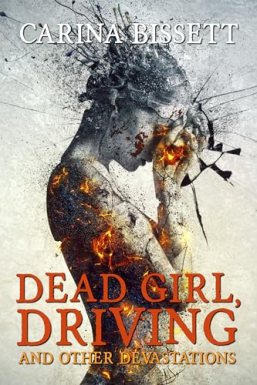
Book Review: Dead Girl, Driving and Other Devastations by Carina Bissett

209001503

Title: Dead Girl, Driving and Other Devastations

Author: Carina Bissett

Release date: March 8th, 2024

*Huge thanks to Carina for a digital ARC of this one!*

Firstly – I owe a huge apology to Carina for the delay in posting this review. I had wrapped up reading it this past Saturday and was planning on posting the review Monday, but on Sunday, I was slammed with a massive head cold, which knocked me down for the count. I’m marginally better, which is letting me get this review up and posted!

Carina and I connected way back in 2019, in the most wonderful of ways. Carina was the first recipient of the Ladies of Horror Fiction Writers Grant and that truly warms my heart. Her short fiction has been published pretty much everywhere and she’s been nominated for pretty much everything!

Which meant, that when she emailed me about a potential review, I was all over it! It felt full circle for me, seeing how we connected, but also knowing just how strong her fiction is, I would be in for a treat!

What I liked: This collection is pristine. Varied. Steady. Masterful. Each story has an energy that crackles and within each, Carina deftly weaves a tale that is immediately striking, but also hits at something deep within the reader. As you can gather from the title and cover art, emotions run high throughout and the breadth of themes within this one made for numerous stories requiring a pause once done, reflection, and in some cases, re-reading parts to mentally digest how bare and exposed Carina’s writing was.

If you read any of my reviews, one thing I’ll often note is that when an author gets to a certain degree of honesty shared through fiction, I’ll refer to it as brave. I think Carina might’ve set the bar here for what I’ll compare every other story – no matter the length – with, from now on.

Standout stories for me were ‘Rotten,’ ‘Water Like Broken Glass,’ ‘Gaze With Undimmed Eyes and the World Drops Dead,’ ‘The Stages of Monster Grief,’ ‘Burning Bright,’ and ‘Dead Girl, Driving.’

‘Gaze…’ particularly stood out. It was a very unique telling of a woman at a hotel in Colorado who dreams of her old life while connecting with her new one. It was fantastic.

But hands down, my favorite story was ‘Cracked.’ The themes within this one are heavy, dealing with fertility, having children, being a single mom and the expectation of birth. It is about a middle-aged woman who gives birth to a massive, ten-pound egg. Carina straddles the line between humor and seriousness, but all the while making the reader reflect on their own perceptions when applied within the context of this story.

Within each story, the worlds, the characters and the themes that Carina have created are ones that will have you hooked and desperately wishing for more, even when you’re relieved when they come to an end.

What I didn’t like: I personally loved each story, some more than others – see ‘Cracked’!! – but overall, the level of storytelling was masterful. But, as always, reader mileage may vary based on personal preferences.

Why you should buy this: Carina’s short story writing is scholarly in its execution. If you’re starting out and want a masterclass on how to tell a story that it impactful but also accessible, this is the perfect collection to snap up and devour. Otherwise, if you’re simply a fan of sumptuous fiction that bleeds from the page, Carina’s collection is simply phenomenal. A must read for all fans of dark fiction collections.

5/5

Book Review: Being Followed by Derek Muk

205393707

Title: Being Followed

Author: Derek Muk

Release date: January 31st, 2024

*Huge thanks to Derek, Dean and Demain Publishing for a digital copy of this!*

We live in some of the most infuriating times. It doesn’t matter where you look, or how you filter your news, every day feels darker, light dimmer, hope a fading belief of a decade ago.

Between Russian and Ukraine, Israel and Palestine, the political landscape in the US, the rise of bigotry, anti-Semitism, far-right movements, and hatred worldwide and even the ever de-funding of Education and Healthcare in Canada, the world just feels like there’s no way to dig ourselves out of these dark holes. I could go on and on, but I’ll pause here, not wanting this to depress us even more.

And in the world of fiction, this is also a boom time. No matter where a writer looks, something is going to piss them off and inspire them to put pen to paper, or fingers to keyboard.

Derek Muk is one such writer. And in this, his newest release, he’s angry, he’s pissed off and he writes with a feverish heat throughout. I’ll share this from the books Goodreads page;

‘Derek Muk says of ‘Being Followed’: “My book is a topical, modern-day, real-life, current events horror story (mixed in with mystery, suspense, thriller, and romance) that mirrors what’s going on in the U.S. and I think readers will relate to that. The book was inspired by racial tensions sparked by the 2017 Charlottesville, Virginia rally, the January 6 coup/storming of the U.S. capitol, the murder of George Floyd, and the fascist atmosphere of the Trump Presidency.”‘

So, now you know what you’re in for.

The story follows Claire, a Jewish woman, who has just released a book looking at socio-political topics. Not long after the book is released, she begins to receive threatening notes. They’re left everywhere, even on her car at the University’s parking are, which she discovers after her class she teachers ends.

From there, things escalate – a break in at her apartment where they leave a horrendous display – and Claire knows that things will only continue to worsen, but she’s not going to back down, not give in to their demands. She contacts her former colleague lover, Albert, who comes to her aide and the two of them try to work through this together, bringing them closer once again.

Muk jumps between present day and their old University times, showing how the two of them connected back then, as well as how they reconnect as the threats ramp up.

Throughout, it’s a difficult read with deep themes that are honestly tough to digest. I see the news. I read the stories, watch the clips, but I don’t personally directly experience any of this. I’m a 40 year old white guy. I try my best to be an ally, to be there for those who need me and to know I’m a safe space, but I don’t get notes left on my car, graffiti painted on my home, or death threats emailed to me. I don’t get yelled names in public, or have strangers come up to me and wish me dead or spit on me.

And that’s the reality for millions of people every day. Millions. That’s not an over exaggeration. I’m writing this review the morning after the current US President, Joe Biden gave his State of the Union address, one in which he was interrupted by the Jewish Space Laser lady, who continues to rail against letting immigrants into the US and who believes that country needs to be more religious and more white. I can’t imagine, sitting there watching that as an ethnicity, who moved to the country to try and provide a better life for my family, and see such hatred on display. And it’s daily.

And Muk’s novella directly addresses that. It hits to the core of it and it’s a novella that I loved and I hated equally. I loved it because of how Claire and Albert are such strong, solid characters and strong, solid people. I hated it because it reads far too close to non-fiction than anything of this nature should.

I’ve eschewed from my usual format of reviewing specifically for this book, because this is a piece that needs to more widely read, is heartbreaking in its message while uplifting in its resilience and I don’t think the message within fits my standard format.

Kudos to Dean, Adrian and Demain Publishing for backing this and giving it the care it needed to be released. This novella may very well become a piece we see used to teach in schools, much like Orwell’s ‘1984.’

Well done, Derek.

5/5

Book Review: All the Fiends of Hell by Adam Nevill

201048401

Title: All the Fiends of Hell

Author: Adam Nevill

Release date: April 2nd, 2024

*Huge thank you to Adam for sending me a digital ARC!*

We’ve been living in a saline world, filled with blues and yellows and a hint of orange. Life goes on. Prices trend upwards, viruses spread and bombs drop on the innocent while all in the name freedom or oil. As we tread water, some of us scream to our reflection each morning in the mirror that ‘things will get better,’ while others look skyward and ask for their savior to return and smite the sinners, praise the followers.

And then…

In the distance…

A redness. Carried on the shoulders of pure, unadulterated dread.

Two years since the seeping terror that was ‘The Vessel’ was unleashed, England’s master of shudder-inducing horror, Adam Nevill appears over the horizon. Bathed in brine and doused in the redness of the bay, he too looks skyward. And what he sees is something none of us will want to have come into focus.

When I first heard about this book – in Adam’s always phenomenal newsletter – I was instantly hooked. An Alien Invasion horror novel from the mind that brought us the blackest books released over the last few decades. Stack his novels ‘Last Days,’ ‘The Ritual,’ ‘Lost Girl,’ ‘Under a Watchful Eye,’ ‘Cunning Folk,’ ‘No One Gets Out Alive,’ ‘Apartment 16,’ and ‘The Reddening,’ and not only do you have close to 4000 pages of fiction, but you also have an encyclopedia of how to literally scare a reader to death. Add in ‘The Vessel,’ and his short fiction, as well as ‘The House of Small Shadows’ and you’re looking at 7500 pages of bone-bleaching blackness. I haven’t yet read ‘Banquet of the Damned,’ (fixing that shortly), but I’ll assume it is no less bleak.

Nevill has found his path, carving it out of the hillside that runs along the ocean’s shore. He walks the line between the old guard – those who were dialogue driven and used that more to guide a story than plot (see Ramsey Campbell, Peter Straub) – and the new guard, where each chapter ends with cliff hangers and we see a psychological torment infused throughout (see Paul Tremblay, Andrew Pyper).

Knowing Nevill would be crafting a story that would be equal parts exhilarating and traumatic (as plucked from a response he gave to someone, I think it was on FB?), I went in knowing I’d purposefully be taking my time. I wanted to savor this. Let each sentence and paragraph ferment in the back of my throat like I was some fancy connoisseur of expensive cheese. Nevill doesn’t just write. He paints. He creates. He unleashes bloody fucking hell on the characters and he doesn’t care if the reader makes it to the end alive. His novels suggest he prefers they don’t.

What I liked:  The story begins in the middle. Karl, sick with the flu and heartbroken over his failings and his divorce, is stuck in bed, mentally deciding on whether it would be better for him to kick this bug and get better or to just go to sleep and never wake up. He’s done with life. Then, during the night, he hears bells and, looking outside, sees his neighbors walk out into the streets, under the glowing redness of something from above, and they all ‘fall in reverse, skyward.’ This opening salvo, this five or so page introduction to this world was harsh enough that I paused here while reading. I put it down and went to another book. It unnerved me more than anything I’d read in some time. Actually, since I read ‘Under a Watchful Eye.’ Nevill’s writing is as close to uncomfortable as The Devil’s Note is on the piano. That tritone that creates such vestibular dissonance that you wish it stop immediately.

But he doesn’t stop there. Karl awakens the next day, not believing the events were real. It was a illness-induced dream, he tells himself. But everyone else is gone. All, except the few stragglers he finds who were also sick when the bells sounded. His neighbor with a disease. A couple kids who also had the flu. A senior’s home with elderly ill patients.

Nevill delivers a few lines that are so real, so uncomfortable that I understood just how perfectly he chooses his phrases. One such moment is when Karl finds all of the neighbors doors are open. Unsettling, yes. But, he wants to check on his sick neighbor. Going to her door, he calls out. No reply. Then he pauses at the front door. He can’t bring himself to go inside. It’s an invasion of someone else’s personal space. Much like a vampire needs to be invited in, Karl feels the same. When he sees the husband at the top of the stairs he forces himself to step over the threshold.

A similar moment happens not long after. Karl takes his car and drives. He comes to an intersection and the light is red. Still, he sits and waits until it turns green. Even with no other cars around and the reality that he is one of the few remaining survivors in the world, he follows those norms of society that are now ingrained in each of us, not wanting to ‘break the law,’ even though no laws will ever exist ever again.

From here, Nevill transforms the book from a straight forward ’28 Days Later’ style narrative – something is breaking glass, flickering in the light of the day, but forming more fully when redness comes across them (but not zombies!) – into something very similar to his masterpiece, ‘Lost Girl.’ Karl, who had his marriage dissolve over the ‘are we having kids’ argument, finds two kids, brother and sister, Jake and Hayley, and takes them under his wing. They immediately all seem to need each other and he wants to protect them.

This is throw on its head when a stranger shows up. The reader will immediately hate this character, and rightfully so. Nevill splits the terror here. 50% devoted to the red sky approaching and 50% devoted to Karl and Jake working together for a common goal. Survival. Retrieval. Vengeance. It’s a trifecta of perfection that Nevill delivers and he delivers it with glee. And each time we hear the haunting squeal of avianish harbingers, we clench our teeth and pray for survival. The horrors, as they’re come to be known as, were done so very well. Nevill uses a ‘less is more’ approach with them, giving us spurts of description but backing off before any of the edges are fully formed, any of the details fully filled in.

The final quarter of this novel is a straight sprint. Even if – like I was – you want to savor it, you won’t be able to slow your pace. It’s as though you’re on a train track and the brakes have failed. We get the sea, we get the horrors growing and approaching and we get Karl and Jake doing whatever needs to be done to keep Hayley safe, and then Karl going above and beyond to get them all to survive.

They very common saying of ‘red sky at night, sailors’ delight, red sky at morn, sailors take warning’ will no longer apply to anyone after reading this novel and having to digest all of the nightmares that’ll come along with it.

Nevill, in the afterword, discusses how H.G. Wells ‘The War of the Worlds,’ was an inspiration to writing this, but I’d also say that there’s a lot of the movie ‘Signs,’ here and not in a bad way. I personally love that movie, and if you’re of a certain age, the scene were Joaquin Phoenix’s characters watches the footage of the creature appearing still haunt’s you to this day. No, the similarities rest in the set piece and the characters. Within this book we have four characters that are prominent throughout, with a fifth arriving later. Much like in ‘Signs,’ were it starts with just the family at the farmhouse. Karl and the kids move along, trying to survive, while the family hunkers down in their home when the aliens arrive. But it’s all about survival and keeping the kids alive and trying desperately to find a way to make it through these horrid events that they’ve found themselves in.

What I didn’t like: From start to finish this novel is a heavy read and as the story progresses, we get more layers, like a weight being added to a bag you’re carrying. The one bit I wish we’d seen more of or learned more of were the things called ‘the left-behinds.’ I won’t go too far into it, as I’m trying to stay spoiler free, but they were so intriguing, I was hoping something would be shared about the how and why.

Why you should buy this: Well, firstly, if you’re a Nevill die-hard, you’re buying this. Secondly, if you live for ‘alien invasion horror,’ you’re buying this. BUT – if you’re not sure of either, buy this to follow one of the best characters I’ve read in some time – Karl. Karl isn’t your typical ‘hero.’ He often contemplates if it would be easier on him if he just killed himself and let whatever will happen, happen to the kids. He wonders if they’d be better off if he leaves them. He’s a real character. Someone who doesn’t believe he can possible save them, but wants to try because he does care, even if he won’t admit it to himself.

Nevill’s storytelling is always a joy to read, even if the books are filled with some of the bleakest moments you’ll ever experience. The master only gets better and with this newest march towards a total red eclipse, we all must bow down and chant skyward, that we abide, and let the redness wash us away.

5/5