
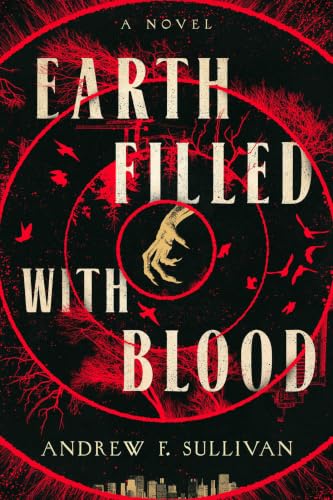
Title: Earth Filled with Blood
Author: Andrew F. Sullivan
Release date: June 15th, 2027
*Huge thanks to Andrew for sending me a digital ARC of this one!*
Back in 1999, the guitar player from the Gothic Death Metal band Paradise Lost released an album that sounds absolutely filthy. It sounds like it was recorded in an open casket while dirt was shoveled down upon the instruments. The album was titled ‘Abandon All Faith.’ The band named Strigoi. After an instrumental opening, the first song is called ‘Phantoms,’ and it opens with these two lines – ‘There is no heaven, there is only hell‘ – and as soon as I cracked open Sullivan’s next novel, the bleakly titled ‘Earth Filled with Blood,’ I immediately thought of that album and specifically that song. Now, it definitely made for easy continuity because the band was named Strigoi, which derive from old Romanian folklore meaning undead or restless souls, and are often referred to as vampires. It doesn’t take long for Sullivan to deviate from the ‘Strigoi’ title, instead labeling the creatures within ‘Abhartach’s’ and I appreciated that.
It also didn’t take long for Sullivan’s writing to remind me of a different band and a different musician – which I’ll discuss shortly, but one thing was clear. After the decaying monolith that was ‘The Marigold,’ and the shotgun blast of cellular and ritualistic degeneration that was his co-authored novel with Nick Cutter – ‘The Handyman Method’ – this one took a different route. This was a Highway 1, back woods-through the back alley slobber knocker. And Sullivan’s taken a step into another realm with his storytelling, one that should elevate him onto tables at the front of stores and casting announcements for the adaptation.
What I liked: The novel follows Buddy Over There, a middle-aged guy who’s shed his previous legal name, who hunts down the creatures who have infiltrated all levels of society and continue to feed without worry of repercussions. They’ve become powerful CEO’s, mayors of off-the-beaten-path towns and everything in between and below, as they accumulate wealth and power. The novel also follows Garrett, an abhartach, born into a family with power, though he’s now being brought into a different family, one with even more power. The Mallodun’s. Garrett has fallen in love with Fiona Mallodun and together they’re looking to change things for the better, and of course, increase the families power and wealth. All the while, Buddy Over There is hunting them, wanting to take them out and cut their heads off.
I’ve said it before, but I often struggle with the vampire genre. It typically doesn’t get me excited or hold my attention. Recently, Michael Wehunt’s ‘Nightjars’ novel managed to crack through my tough outer shell, and a huge part of that was the fact the novel felt dirty. Felt as though the pages themselves were blood-soaked and mud-caked. And the same quickly became apparent with this one. Buddy Over There doesn’t have a padded bank account allowing him to wear crisp, tailored black suits. He doesn’t kick in doors while flipping open his briefcase and pulling forth a weapon from his unending arsenal of guns to blast the bad guys to bits. No, he steals cars, snatches wallets and finds abandoned houses with mattresses that aren’t soiled to sleep on. He’s a guy who does what it takes to rid the world of the scourge that is the abhartach’s. And it was while reading Buddy Over There’s parts that I really felt like this was a novel set within the world of an album from Canada’s Headstones. As the novel went on, all I could picture was Buddy Over There played by Headstones lead singer (and actor) Hugh Dillon. Headstones write gritty, filthy songs detailing life without a filter and it just fit.
The novel bounces back and forth between Buddy Over There and Garrett. We see Buddy Over There killing a group of the vermin in a house, only to find a girl in the trunk of the car. Trunk, he names her, and the two of them become inseparable, Buddy teaching her the ways, while also hunting the Malludun’s. We get little snippets of Buddy revealing different experiences he’s had across Canada while hunting these things and I found that Sullivan painted an entire short story within even a few sentences. I loved those mini-vignettes where Buddy would say what he did in Lethbridge or Abbotsford or Winnipeg.
Garrett meanwhile finds himself in a power struggle as Fiona and the other siblings try and deal with the order of the organization, external threats and what needs to be done to ascend to ultimate power. Sullivan treats this half of the novel like a Soprano’s script, with moving parts like a chess game and each action causing reactions. It’s a domino effect of cat and mouse moments, all the while Garrett believing he’s leaving the life he had previously behind.
It all leads to a head, the two storylines merging and cinematic ending. Personally, I think it was very well executed with a few unique set pieces – excellent use of a swimming pool FYI – and Buddy Over There recognizing what role he plays in this story and what he needs to do keep the good fight going.
What I didn’t like: This will be completely a reader thing, but I personally loved the Buddy Over There chapters more than Garrett’s chapters. I think that’s because I’m not a family power fan. I don’t watch shows like Mayor of Kingstown (Easter Egg!), Mobland, Yellowstone, etc. because they just don’t really do anything for me. My wife on the other hand loves them. So, depending on what your personal tastes are, you may be the opposite. Because of that, I always found myself desperately waiting for the Garrett chapters to end so I could return to see what Buddy was up to.
Why you should buy this: A novel that takes a larger folklore idea – this one emerging from Irish folklore – and firmly planting it into the soil of Canadiana, Sullivan’s delivered perhaps his Magnum Opus. A multi-layered, emotion-driven piece, this has every element I look for in a novel to devour and then some. I came to really know and root for some characters, while others I wished with each passing paragraph to see their downfall. This felt like a Shakespearean epic, updated to a modern day setting and then shrouded in the carnage of these creatures.
From start to finish, Sullivan had me hooked and I’m thankful that he took the abhartach mythos and made it his own. They have powers and the ability to heal, but they can also die. And in this case, Sullivan makes sure those deaths are hideous, brutal and masterfully executed.
And don’t worry. I’m pretty sure we got a few ‘The Marigold’ Easter Eggs in here as well.
Phenomenal.

